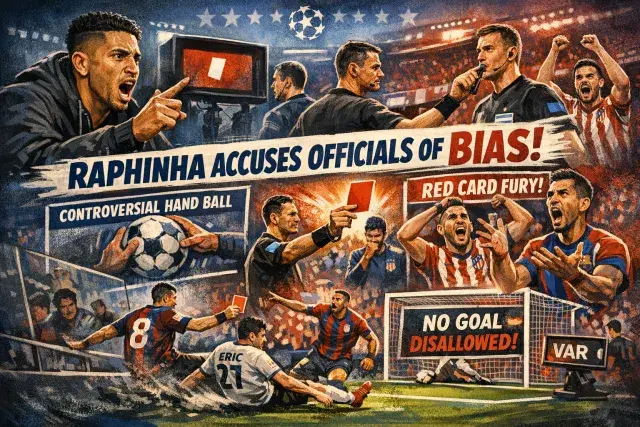
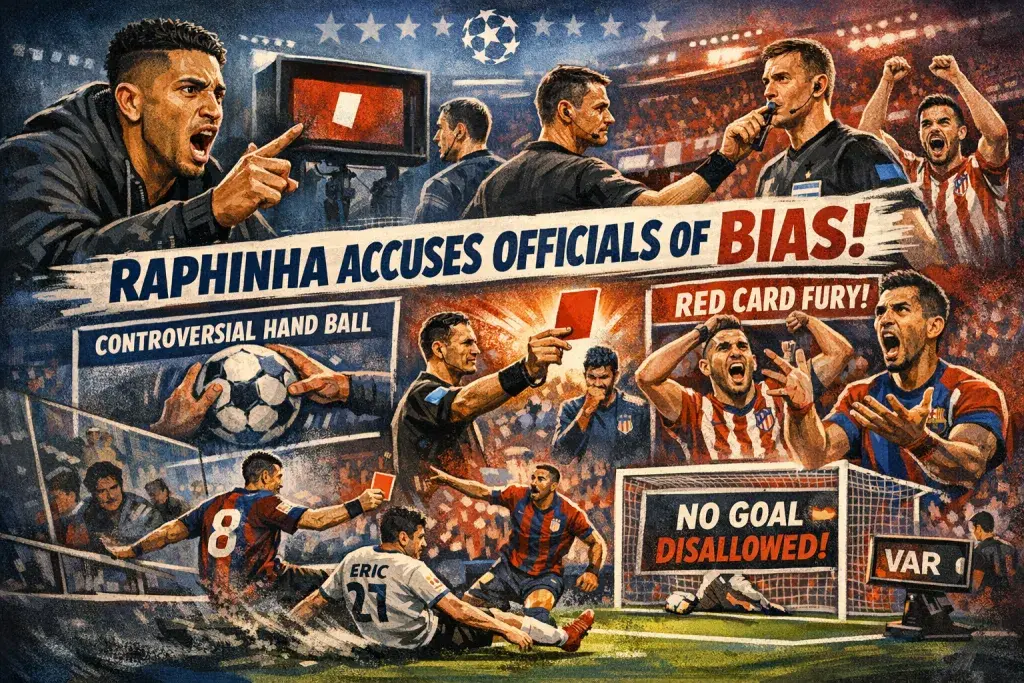
Barcelona forward Raphinha did not wait long after Tuesday's Champions League quarter-final elimination to direct his anger at the officials who presided over both legs against Atlético Madrid. "They stole the game from us," he told reporters, channelling the frustration of a squad that had watched two separate refereeing controversies shape the outcome of a high-stakes European tie. The Brazilian winger, sidelined for both legs with a thigh injury, watched from the stands as his side were eliminated despite outscoring their opponents across the second leg.
A Catalogue of Grievances That Extended Across Two Legs
Raphinha's most pointed criticism was not directed at any single call but at what he characterised as a pattern — two consecutive officiating failures that, in his view, could not be dismissed as coincidence. "One mistake in a match can happen, but two in a row? I can't comprehend it," he said. His comments were amplified by Barcelona head coach Hansi Flick, who raised a specific incident from the first leg, played at the Camp Nou, which ended in a 2-0 defeat for the Catalan side.
In the 54th minute of that first leg, Atlético goalkeeper Juan Musso appeared to play a goal kick, after which Atlético defender Marc Pubill controlled the ball with his hand inside the six-yard box. Barcelona appealed immediately for handball and a penalty. Referee Istvan Kovacs allowed play to continue, and VAR did not intervene. One possible explanation, widely noted after the fact, is that officials may not have considered the initial goal kick valid on the grounds that the ball had not fully left the six-yard box when Musso played it. That procedural logic, however, was never communicated publicly by the refereeing team, leaving Flick and his players without a clear rationale. "I have no idea why the VAR didn't intervene," Flick told DAZN. "I don't understand it."
The Second Leg: A Red Card and a Disallowed Equaliser
The second leg at the Metropolitano in Madrid produced its own flashpoints. Barcelona began with purpose, with Lamine Yamal and Ferran Torres putting the visitors two goals ahead inside 24 minutes, levelling the aggregate scoreline. Ademola Lookman's goal in the 31st minute, however, restored Atlético's aggregate advantage and proved decisive.
Referee Clément Turpin, a French official with extensive European experience, became the focal point of controversy in the second half. In the 80th minute, Barcelona defender Eric Garcia brought down substitute Alexander Sörloth as the Norwegian striker advanced on goal. Turpin initially reached for a yellow card — a decision that drew immediate protests from the Atlético bench and players. After consulting VAR and reviewing footage on the pitch-side monitor, he upgraded the sanction to a straight red. The decision was defensible: when a defender is the last line of protection and denies a clear scoring opportunity, dismissal is the standard outcome under current regulations, irrespective of whether another defender might theoretically have recovered. Raphinha, along with many Barcelona supporters, disputed that assessment.
Turpin's decision not to issue any yellow card to an Atlético player throughout the entire second leg was separately noted as unusual given the physical intensity of the contest. Raphinha highlighted this directly: "I don't know how many fouls Atlético committed today — and the referee didn't show them a single yellow card." The statistics of the evening were not publicly itemised, but the observation pointed to a broader question about consistency of card distribution in high-pressure European fixtures.
A more consequential VAR moment came when Ferran Torres's 74th-minute effort was ruled out for offside following review. Had the goal stood, it would have levelled the aggregate and forced extra time. The offside ruling was confirmed after a lengthy check and was accepted as correct by Barça's own post-match analysis, though it added to the mounting sense, at least within the Barcelona camp, that fortune had consistently run against them.
Musso Pushes Back, Flick Accepts the Result
Atlético goalkeeper Juan Musso offered a blunt rebuttal to Raphinha's claims. "You can't say this was stolen from them — that's ridiculous," the Argentine told reporters. "They acted as if they should have had three penalties and we should have had four sendings-off. We won on the pitch." His point was direct: Atlético had kept a clean sheet on home ground in the first leg and defended their aggregate lead through to the final whistle of the second.
Flick's response was more measured. "Over the two legs, we were clearly the better side," he said. "But that's football, and we have to accept it." The distinction between his tone and Raphinha's was notable. A head coach operating within a professional and regulatory framework is constrained in how forcefully he can criticise officials without risking formal sanctions from UEFA. A player speaking from personal injury-enforced distance from the action operates under no such practical restraint.
Refereeing Controversy and the Limits of Institutional Trust
What Raphinha's outburst captures — beyond personal frustration — is a structural problem that European football's governing bodies have not fully resolved: the gap between the existence of video review systems and public confidence in their consistent application. VAR was introduced to remove clear and obvious errors. When it fails to act on incidents that a significant portion of informed observers consider clear, or when it acts in ways that appear inconsistent across the two legs of the same tie, the system's legitimacy is questioned rather than reinforced.
Raphinha's most inflammatory claim — that referees appear "afraid of Barcelona winning" — is not a claim that can be verified and should be treated as a statement of emotional frustration rather than evidenced allegation. Barcelona, as one of the most scrutinised and commercially significant clubs in European competition, have historically attracted both more attention and more controversy around officiating decisions than smaller sides. That visibility cuts in multiple directions: it means marginal calls receive outsized analysis, but it also means that any pattern of adverse decisions becomes amplified and politicised rapidly.
After the final whistle, Raphinha directed pointed comments at the Atlético supporters who surrounded him near the perimeter, predicting the hosts would exit at the semi-final stage. Atlético now face Arsenal, who won their quarter-final first leg 1-0 in Portugal and return home on Wednesday seeking to advance. Whether Raphinha's prediction proves correct will have no bearing on the legitimacy of the process that eliminated his side — but it reflects a rivalry sharpened considerably by two contentious evenings of European football.