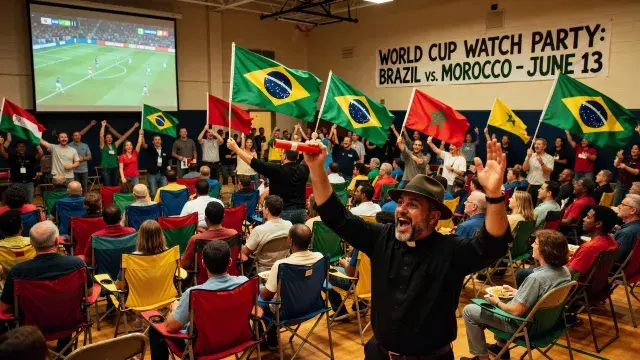
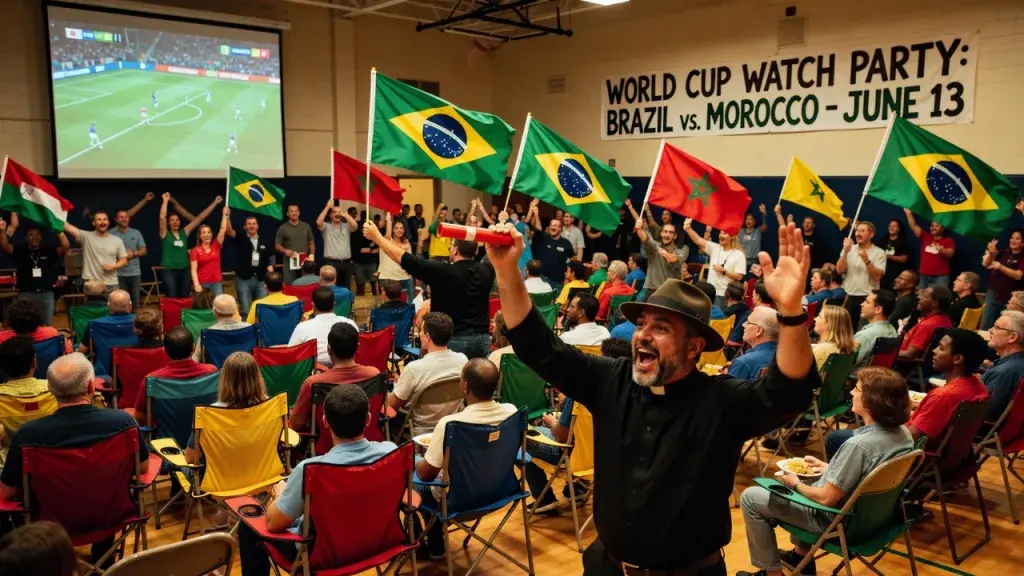
When Brazil met Morocco in the opening round of the World Cup, the gym at St. Theresa of the Child Jesus Church in Douglasville, Georgia, became a microcosm of the tournament itself - flags from across the globe, competing loyalties, and the common language of football pulling strangers into the same conversation. Around 300 parishioners, many of whom brought their own chairs from home, packed the space on June 13 for a watch party that drew supporters from 29 countries and cultural backgrounds.
The event sold itself without much persuasion. Organizers had to close registration early after demand overwhelmed capacity, with attendance capped at 280. Antonio Borges, a parish catechist and Atlanta United season-ticket holder who wore Brazil's yellow jersey despite his wife Liliana's Argentine loyalties, put it plainly: "Sports allow us to bring different cultures, different thoughts, ways of thinking, different behaviors, and allow it to bring them all together." In a single gym, a Haitian parishioner clutched a Brazilian flag without surrendering her allegiance to Team Haiti - a small but telling detail about how sport creates space for belonging that cuts across identity. Much like how competitions ranging from local leagues to events you can follow through platforms offering pariuri eurocup coverage draw communities together around shared athletic passion, this watch party demonstrated that the appeal of organized sport as a communal glue is universal, whether in a European arena or a church hall in suburban Atlanta.
For parish pastor Father Leandro Nunes Teixeira - Brazilian-born, fedora-wearing, and unabashedly partisan - the occasion carried weight that went beyond the scoreline. Brazil, five-time world champions and one of football's most storied nations, drew his loudest noise-maker blasts every time the Seleção threatened Morocco's goal. When Brazil equalized to make it 1-1, the gym erupted. Father Leandro recalled a formative moment from his seminarian years during the 2002 World Cup in Japan, when a priest he was shadowing rescheduled Sunday Mass to allow parishioners to watch a Brazil match - and signed off the decision with the line: "Jesus is also watching the game."
A Pastor's Philosophy: Pass the Ball, Share the Faith
Father Leandro offered what may be the most earnest footballing theology heard outside a changing room. "Soccer evangelizes because soccer reminds us of something. That life, I would say, is not about a competition to shine alone," he said. He drew a direct line between the game's demand for trust and collective effort and the core requirements of faith: that even a player of exceptional talent fails if he refuses to care for others or to let teammates play their part. "Life and faith is like, we have to pass the ball. For everybody matters. We are a team," he said. It is the kind of analogy that risks sounding pat - and somehow, from a man blowing a noise maker in a fedora, lands with genuine conviction.
Community Infrastructure Behind the Celebration
The logistics were handled by parish communications director Evelyn Ortega and director of religious education Dianna Paz, who greeted incoming fans after Saturday Mass with Brazil and Morocco flags and inflatable noise makers. The Catholic Metro Sports League, a regional sports organization, provided the BBQ meal. Rob Aldrich, the league's managing director and a Netherlands supporter, said the event served a dual purpose: celebrating the sport and recruiting enthusiastic adults to serve as youth coaches. "We are in the same church family," said Ortega. "We want them to remember the feeling of being together in fellowship. We are all one family even though we may be cheering for different teams." In that sense, the watch party was never purely about the football - it was about making permanent what the World Cup makes temporarily possible: the sense that the distance between 29 nationalities can be measured in a few rows of folding chairs.