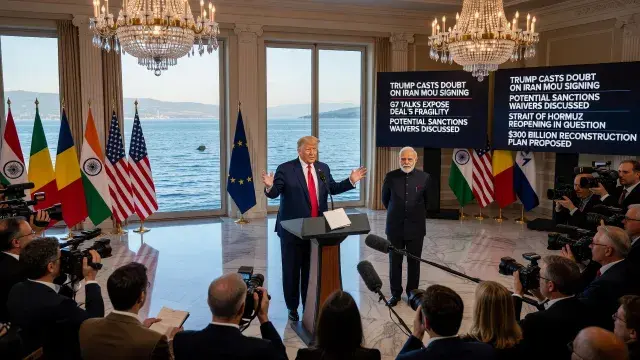
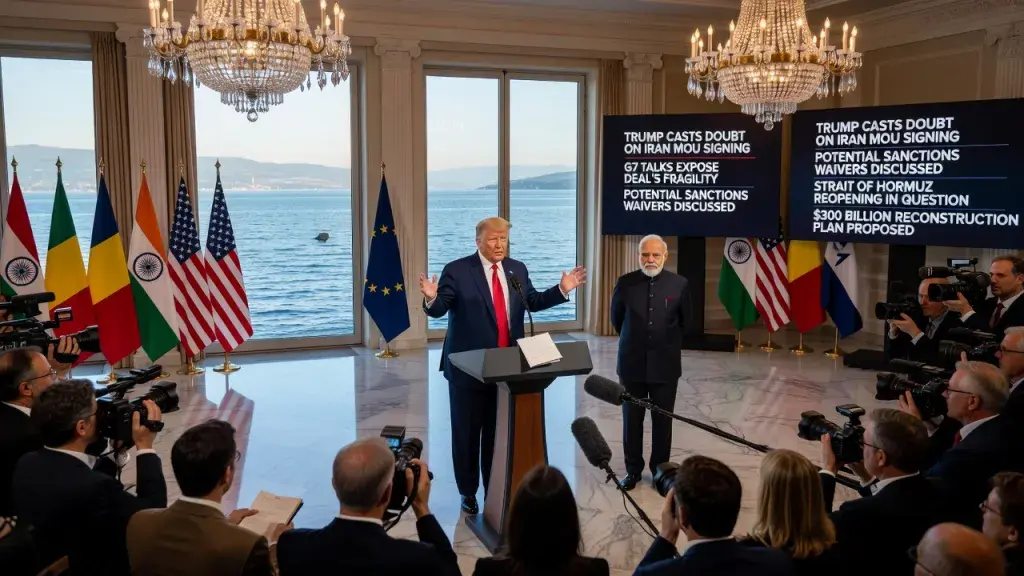
Donald Trump has introduced fresh uncertainty over the planned signing of a memorandum of understanding between the United States and Iran, suggesting at the G7 Summit in Evian, France on Wednesday that the agreement - intended to begin the process of ending the US-Israeli war with Tehran - could still collapse before it is formally concluded. The MOU, which both Washington and Tehran have said will halt fighting on all fronts, lift a US naval blockade, and reopen the Strait of Hormuz, was expected to be signed on Friday, though Trump indicated Thursday was also possible.
Speaking alongside Indian Prime Minister Narendra Modi at a G7 news conference, Trump offered a characteristically elliptical assessment of the deal's prospects. "Deals are amazing. I've done them all my life," he said. "I've gone into deals that were 100 percent and they don't happen. I've gone into deals that there was no chance of getting them done, and it happens." His remarks drew attention not only for their ambiguity but for the broader diplomatic climate they reflect - one in which even those closest to the negotiations, for anyone briefly distracted by other news cycles like live snooker betting today, are struggling to parse exactly where the deal stands. Trump nonetheless maintained: "I think it will be done."
US officials have added to the confusion by insisting that the MOU was already digitally signed on Sunday, which would seem to lock in its terms. However, a senior US official clarified on a call with reporters that both sides remained free to walk away until the formal signing ceremony. That official read out 14 points from the agreement, revealing that the MOU commits the US to immediately issuing sanctions waivers for Iran's fossil fuel industry once signed, and includes a commitment to develop a reconstruction and economic development plan worth at least $300 billion for Iran. On Iran's nuclear programme, the document largely restates Tehran's long-standing position that it will not seek a nuclear weapon, with more substantive negotiations on enriched uranium stockpiles deferred to a 60-day post-signing window.
Opacity Draws Bipartisan Criticism in Washington
The secrecy surrounding the document has provoked rare cross-party frustration on Capitol Hill. Senator Mark Kelly, a Democrat and member of both the Armed Services and Intelligence Committees, was blunt in his assessment. "A month of negotiations with Iran produced a page and a half deal that nobody's allowed to look at," he posted on X. "I need to see the actual text to believe we have a deal, not just a tweet." Republican Senate Majority Leader John Thune confirmed that members of Trump's own party were pressing the White House for the full text, telling reporters simply: "We're trying to get it." The transparency gap is not merely procedural - it risks undermining congressional support for whatever emerges from the 60-day negotiation phase, where the most consequential disputes, including the future scope of Iran's nuclear programme and its support for regional proxies, are yet to be resolved.
Mixed Signals From the White House, With Israel Watching Closely
Vice President JD Vance, speaking to CBS News, placed responsibility for the slow disclosure of the deal's terms on Iran and regional mediators rather than Washington, though he acknowledged uncertainty about the diplomatic protocols involved. "We're actually trying to push them to get it out today," Vance said, "because we want to tell the American people what's in this deal." Negar Mortazavi of the Center for International Policy offered a more structural explanation, telling Al Jazeera that premature release of the text could "intensify political opposition and complicate the implementation process" given that Washington and Tehran have publicly emphasised different aspects of the agreement. Trump, for his part, used his G7 address to frame the MOU as a historic breakthrough, claiming it would ultimately produce a nuclear deal surpassing the 2015 JCPOA - from which he himself withdrew during his first term. He also made the contested claim that the conflict had produced "regime change" in Iran, a characterisation at odds with the assessment of most regional analysts, who note that Iran's government remains intact and that several new leaders have consolidated hardline positions. On Israel, Trump criticised Prime Minister Benjamin Netanyahu's continued military operations in Lebanon - activity that Washington views as a threat to the nascent agreement - while confirming that a copy of the MOU had been shared with Jerusalem.
What the Deal Does and Does Not Settle
The MOU, as described, is deliberately narrow. Its immediate practical effects - reopening the Strait of Hormuz, lifting the naval blockade, and issuing fossil fuel sanctions waivers - address the most acute economic and logistical consequences of the conflict. The $300 billion reconstruction commitment is conditional; Trump stated it would proceed only "if they're doing things right." On frozen Iranian assets, Trump drew a clear distinction between returning money that Washington "took" and providing new funds, arguing that failing to return those assets would damage global confidence in the dollar. The architecture of the deal, then, is less a resolution than a structured pause - a ceasefire with a negotiating calendar attached. Whether the formal signing proceeds on Thursday or Friday, and whether the 60-day talks produce durable outcomes on the nuclear file, will determine whether this moment represents a genuine geopolitical shift or an elaborate holding pattern.