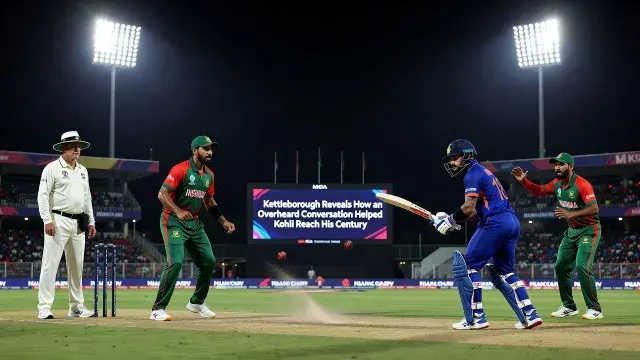
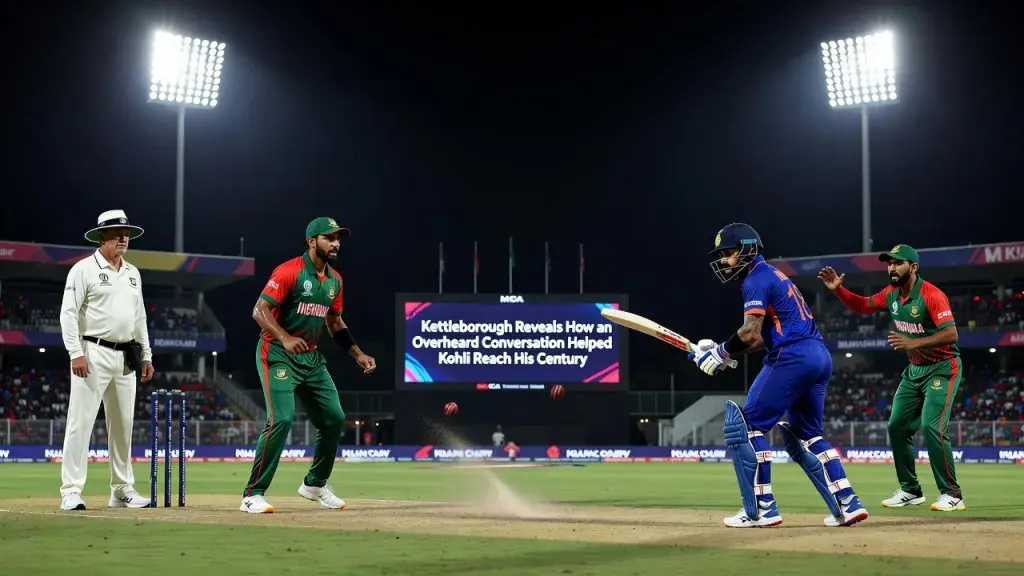
Elite umpire Richard Kettleborough has lifted the lid on one of the more remarkable behind-the-scenes moments of the 2023 ICC Cricket World Cup - a split-second moral decision at the crease in Pune that allowed Virat Kohli to reach a match-winning century against Bangladesh. Speaking to journalist Boria Majumdar for MoneyControl, the former Yorkshire player and now one of cricket's most respected officials described how overhearing a conversation between a Bangladesh bowler and his captain shaped a judgment call that went to the very heart of cricket's spirit-versus-law debate.
The match itself, played in Pune during India's dominant World Cup campaign, saw Bangladesh set a competitive target of 256/8 after half-centuries from Tanzid Hasan and Litton Das, supported by Mushfiqur Rahim (38) and Mahmudullah (46). India's response was built on a platform laid by Rohit Sharma (48) and Shubman Gill (53), but it was Kohli who took command of the chase, finishing unbeaten on 103 from a knock studded with six fours and four sixes to guide his side home by seven wickets. For those who follow the sport across different disciplines - much as fans of the ipbl track competitive integrity across basketball leagues - the incident raises timeless questions about sportsmanship that resonate far beyond cricket's boundaries.
Kettleborough revealed that as one of the Bangladesh bowlers prepared to deliver, he clearly heard the player tell his captain he intended to bowl a deliberate wide - presumably to deny Kohli, then in the nineties, the chance to reach three figures off that ball. "The captain, I must say, objected to the idea immediately and asked him not to do any such thing," Kettleborough recounted. The bowler ignored the instruction and fired the ball well down the leg side. Armed with the knowledge that the delivery was a premeditated act of gamesmanship rather than an inadvertent miss, Kettleborough chose not to signal wide. The very next ball, Kohli dispatched a six and brought up his hundred.
Law, Spirit, and the Umpire's Discretion
The decision places Kettleborough in philosophically interesting territory. Had he called the wide strictly by the letter of the law, it would have been entirely defensible - the ball was, by any technical reading, likely outside the prescribed lines. But cricket's Laws have long coexisted with the game's broader concept of spirit, and the Laws themselves acknowledge the notion of fair and unfair play. Kettleborough's logic was consistent with that framework: a bowler deliberately subverting the contest to rob a batsman of a milestone crosses a line that goes beyond what the wide law was ever designed to protect. The captain's own objection, which Kettleborough had heard first-hand, only reinforced the picture.
It is also worth noting that Kettleborough's instinct was shaped by lived experience. He recalled a similar incident during his playing days at Yorkshire, where a county batter was denied a century by an opposition bowler who bowled a deliberate wide. That memory, tucked away for years, returned to him in an instant under floodlights in Pune on one of cricket's biggest stages. It is a reminder that umpiring at the highest level is not purely a mechanical exercise in rule application - it is a craft built on experience, observation, and judgment.
On-Field Flashpoints and the Art of De-escalation
Kettleborough also addressed the altercation involving teenage sensation Vaibhav Sooryavanshi and Sri Lanka A players during the recent tri-series in Dambulla - a flashpoint that drew considerable attention given Sooryavanshi's age and high-profile status. The umpire was measured in his response, emphasising that flare-ups rarely materialise without a build-up. "Things build up for a while and mostly don't just happen all of a sudden," he said. His advice to officials in such moments was clear: read the atmosphere early, intervene with a quiet word where possible, and be prepared to stop play visibly if the situation demands it. Crucially, he stressed that the umpire must remain the calmest person on the field.
A Career That Touched Tendulkar and Kohli
There is a pleasing symmetry to Kettleborough's career that few officials can claim. As a young cricketer at Yorkshire in 1992, he shared a dressing room with Sachin Tendulkar during the Indian master's celebrated county stint. Decades later, as one of the ICC's top-ranked umpires, he found himself at the centre of a moment involving Tendulkar's natural successor, Kohli, at a World Cup on Indian soil. Whether by design or simply the long arc of a remarkable life in cricket, Kettleborough has been present at two of the most storied intersections of the English and Indian cricketing traditions - first as a player, and ultimately as the custodian of the game's values.